Ruhee Maknojia
Sat Mar 21, 2026 - Thu May 7, 2026
Opening Reception Saturday, March 21, 7-9pm
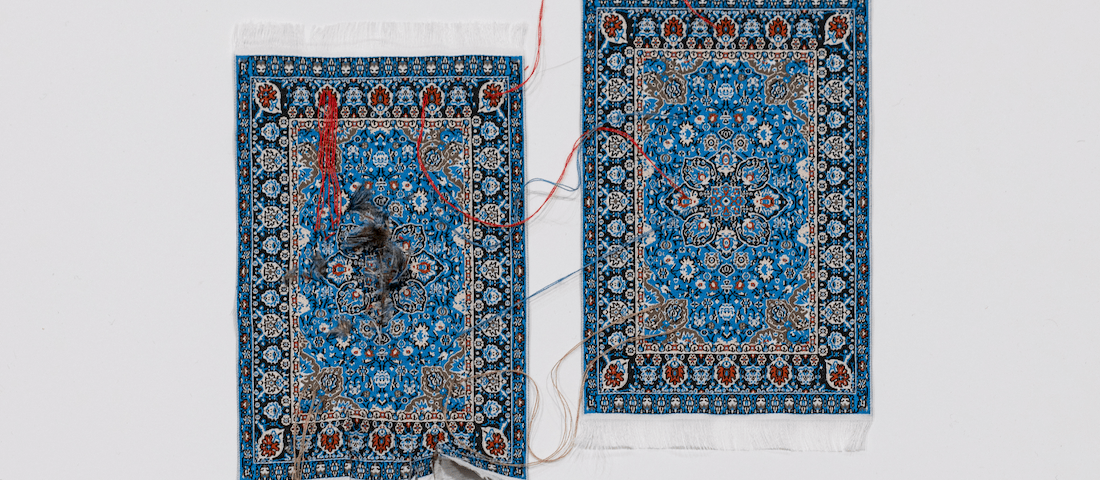
In Fabricating Authenticity, Ruhee Maknojia traces the history of the Ardabil Carpets, a pair of monumental Persian rugs woven in the 16th century. Maknojia invites viewers to question how institutions manufacture authenticity and how narratives are constructed through display.
The Ardabil Carpets, twin Persian rugs originally created for the shrine of Shaykh Safi al-Din Ardabili in Ardabil, embody extraordinary craftsmanship as well as a complex history shaped by imperial intervention. By the late nineteenth century, both the shrine and the carpets had fallen into disrepair. In order to fund necessary repairs, the custodians sold the rugs to a carpet dealer, who restored one carpet using fragments from its twin, effectively producing the illusion of a singular, “complete” artifact.
The carpets were eventually acquired by London’s Victoria and Albert Museum, which held both rugs in its collection for many years but exhibited only the more pristine example as a singular, perfect object. Significantly, to this day, the museum does not acknowledge the twin rug. This act of reconstruction, paired with the obscuring of its restoration history, reflects broader imperial strategies that shaped how objects from the “Orient” were curated, displayed, and interpreted.
The fragmented twin disappeared from public view for decades. Now housed at the Los Angeles County Museum of Art, its damaged condition exposes how cultural objects are reshaped to serve geopolitical and ideological interests.
This exhibition approaches the Ardabil Carpets through their separation, focusing on the poetics of the broken pair and the narratives produced through their fragmentation. The installation translates their central medallion motif into an architectural and reflective environment.
At the center of the gallery, two large mirrors, installed as twins, echo the carpets’ iconic central pattern and rest on a low rising platform. Positioned horizontally, the mirrors invite viewers to look downward into their surfaces. In doing so, the viewer encounters their own reflection within the medallion form, evoking the ways in which spectatorship, display, and power intersect. The act of looking down becomes a quiet metaphor for the gaze of the empire and the structures of authority that shape how cultural objects are framed and understood.
Surrounding the central mirrors, the gallery walls are adorned with thousands of small mirrors that mimic the patterned structure of the central medallion. These reflective fragments create a dispersed field of repetition, recalling the intricate geometry of the carpets while also suggesting fragmentation and multiplicity.
Together, the installation transforms the gallery into a reflective chamber where viewers are placed within the historical and political frameworks that produced the carpets’ separation. By translating the carpets’ pattern into a constellation of mirrors, the exhibition examines how cultural artifacts are recontextualized through systems of display, revealing the subtle ways aesthetic objects participate in the construction of historical and political stories.
About the Artist


